
Introduction to Lumanu
How Lumanu Works
Lumanu is built for platforms running creator-based campaigns that need to support payments.
Core PrincipleYou decide who gets paid, how much, and when. Lumanu takes care of the how. We move and hold the money – in a way that is compliant, auditable, and scalable across many brands and vendors, and compatible with how their finance teams already work.
As platforms scale, payments stop being a background concern and start intersecting with:
- Customer finance teams (often at large brands)
- Auditability and approvals
- Compliance, tax, and vendor onboarding
- Increasingly opinionated funding workflows
At that point, payments stop being a feature and start becoming operational risk. Lumanu exists to handle payments without forcing your platform to become the system of record for money, while still giving you control over how payments are initiated and managed.
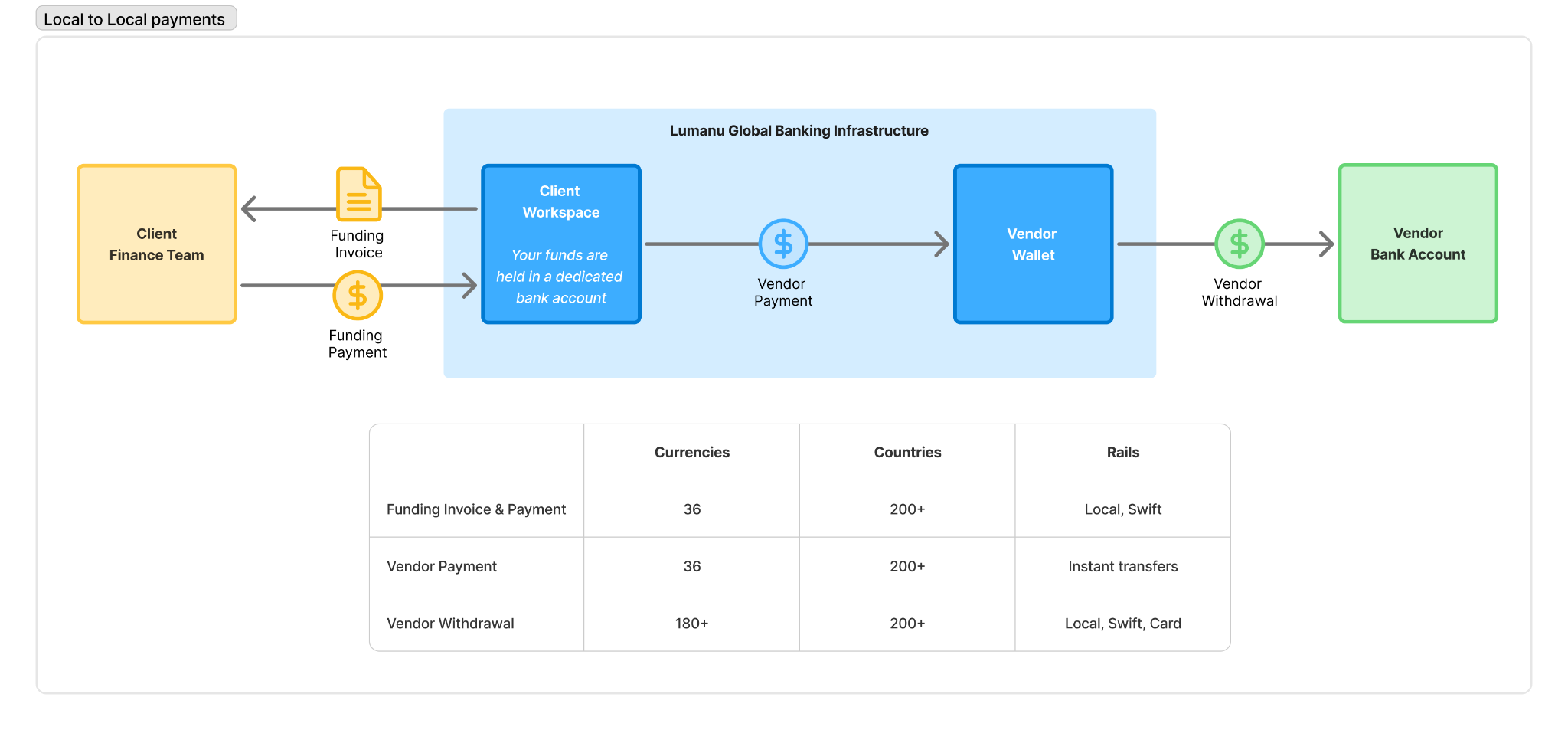
The Lumanu Mental Model
Lumanu introduces a small set of primitives that mirror how money already moves through real organizations. Once these primitives are understood, the model itself is straightforward.
A workspace represents a distinct financial entity.
In practice, workspaces are often 1:1 with the tenants, clients, or brands your platform already supports.
Each workspace has:
- Its own balance and ledger
- Its own approvals and funding lifecycle
- A dedicated bank account and routing number provided by Lumanu
This external addressability is crucial. A customer's finance team can:
- Receive a funding invoice
- Pay it from their existing bank systems
- Reconcile it using the same workflows they already use for other vendors
Lumanu's workspaces are designed to integrate cleanly with how finance teams already operate.
A vendor is any party that receives payment: creators, influencers, agencies, or contractors.
Vendors are onboarded once across the Lumanu network:
- Identity and tax information is collected a single time
- Payment details are reused
- Vendors do not need to re-onboard each time they are paid by a new brand or platform using Lumanu
Lumanu’s vendor model allows:
Payables and funding can exist before onboarding
Platforms can create payables and complete approval and funding workflows even if a vendor has not finished onboarding. Funds are only released once onboarding is complete, but payment intent and approvals are never blocked on compliance steps.
Flexible payout options
Vendors can choose how they are paid, including ACH, push-to-debit, and international payouts via SWIFT or local payment rails. Lumanu handles payout complexity so platforms don't need to manage country-specific rules or payment methods.
Visibility into payables
Vendors have visibility into payables addressed to them, reducing support overhead and increasing trust. Vendors can see what they are owed and when payment is expected.
A payable represents an obligation to pay a vendor:
- Who should be paid
- How much
- For what
Payables answer the question: "What payments should happen?"
Creating a payable does not move money.
This separation allows your platform to remain the system of record for campaign logic and business context, while Lumanu ensures payments are executed correctly, compliantly, and with proper financial controls.
Funding is the act of moving money into a workspace so that payables can be paid.
Funding is a separate step because, in real-world workflows:
- Money is often sent by customer finance teams, not programmatically
- Funding frequently happens in batches
- Approvals often occur before money moves
By modeling funding explicitly, Lumanu aligns with how organizations already manage money.
Funding Invoices and Deposits
When a workspace needs funds:
- A funding invoice is created for a specific amount
- The invoice is paid externally (ACH, wire, etc.)
- Funds arrive in the workspace's dedicated bank account
- Once recognized, the workspace balance increases and payables can be paid
This structure provides:
- Clear traceability between invoices, deposits, and balances
- Strong auditability for customer finance teams
- Clean separation between platform logic and customer funds
The dedicated account and routing number are a core interface, enabling Lumanu to fit directly into existing finance operations.
Funding Flows
Lumanu supports multiple funding patterns using the same primitives.
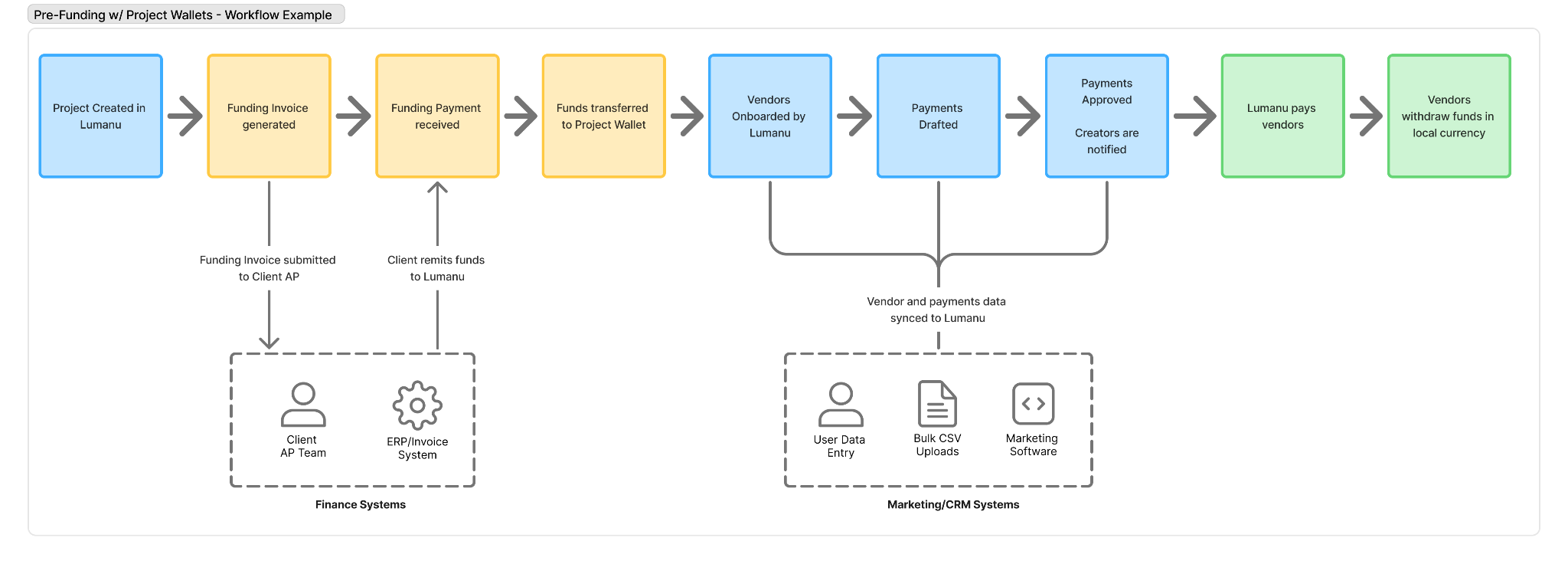
Money is deposited into the workspace first, and payables draw down from the available balance.
This is common when:
- Budgets are known and funds available in advance
- Customers want to ensure their vendors are paid quickly without finance delays
- Customers want predictable funding cycles
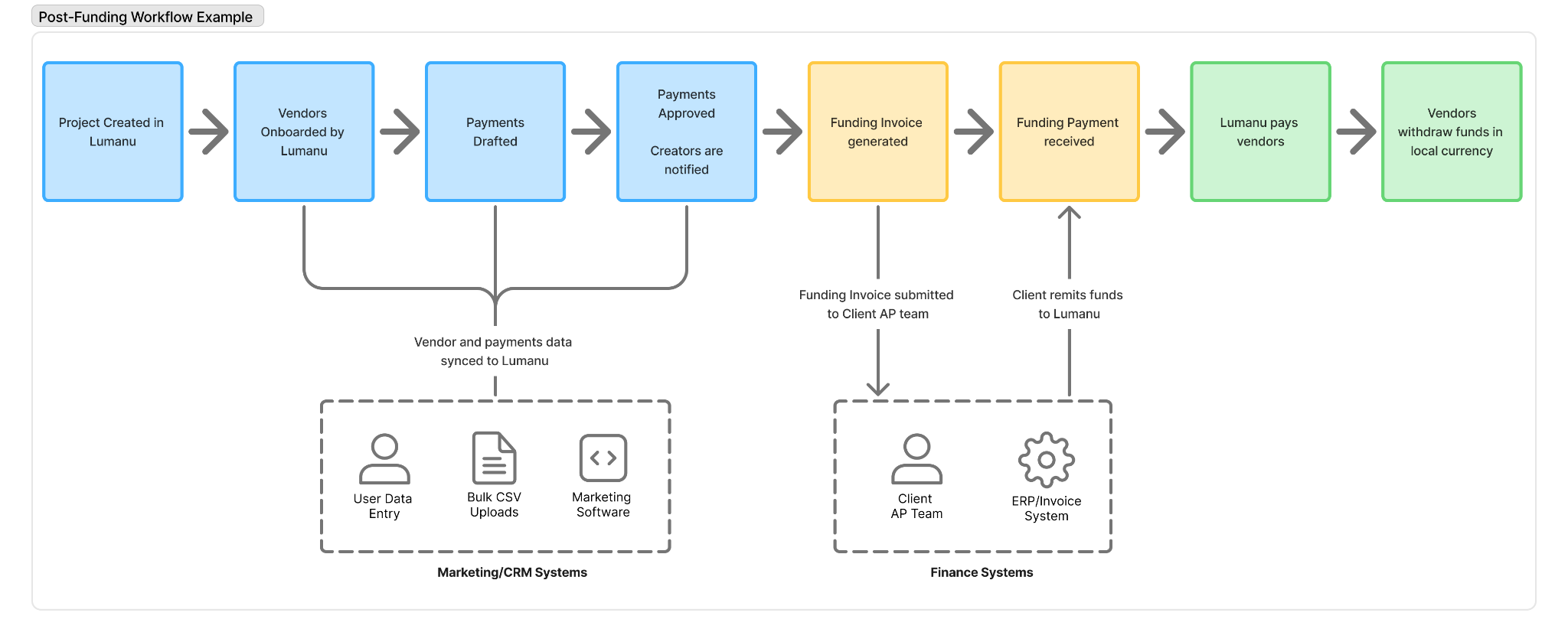
Payables are created and approved first, then a funding invoice is generated to cover those obligations.
This is common when:
- Customers want tight invoice-to-payment traceability
- Approvals must happen before money moves
- Payments need to align closely with specific deliverables
Lumanu supports using both flows in the same workspace. In both cases, funding remains explicit and auditable.
Why This Model Exists
Lumanu's model is designed to be compatible with how money already flows through large organizations.
Rather than optimizing solely for speed of first payout, Lumanu optimizes for:
- Correctness
- Auditability
- Compatibility with customer finance workflows
Once the separation between payables and funding is understood, the core model is simple:
- Define who should be paid and for what services/deliverables
- Fund the workspace
- Let Lumanu handle execution, compliance, and vendor payouts
How Lumanu Fits Alongside Your Product
Most platforms already have a way to move money.
The harder challenge is supporting:
- customers with their own funding and approval workflows,
- finance teams that require invoices and reconciliation,
- and vendors who expect compliant, flexible, and transparent payments.
Lumanu is designed to fill this gap:
- Your platform remains the source of truth for campaigns and payment decisions,
- Lumanu becomes the system that moves and holds money in a way your customers already understand and trust.
Your platform can be in the money flow — or not:
① Platform is in the money flow
Brand ──▶ Platform ──▶ Lumanu ──▶ Creators- Brand pays Platform
- Platform funds Lumanu
- Platform users add & approve payments in Lumanu or via CSV/API
- Lumanu handles vendor onboarding, compliance, and pays creators
② Brands fund Lumanu directly
Brand  ──▶  Lumanu  ──▶  Creators
              ▲
Platform (adds & approves payments)- Brand funds their Lumanu wallet
- Platform is not in the money flow
- Platform users add & approve payments in Lumanu or via CSV/API
- Lumanu handles vendor onboarding, compliance, and pays creators
What To Do Next
If this model resonates, the next step is not just reviewing API endpoints.
Lumanu works best when:
- These primitives are mapped intentionally to your existing product concepts
- Funding flows align with how your customers already operate
- Integration decisions are made with a clear understanding of responsibility boundaries
Our team regularly works with platform partners to help:
- Map Lumanu's model to existing architectures
- Identify where Lumanu replaces or complements current payment systems
- Design an integration approach that makes sense now and as you scale
Updated 9 months ago